
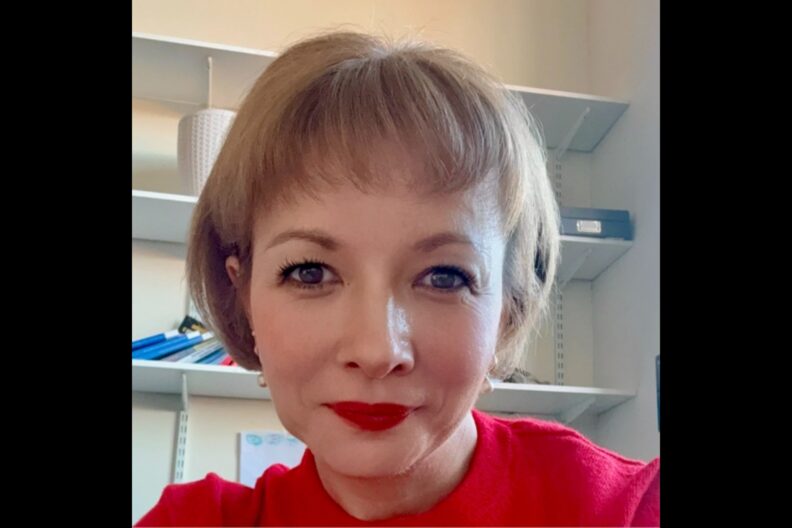
Dr Marina Freitag
“The choices made now will determine whether research in the UK remains as competitive and inclusive as it has been in the past.”
When Professor Marina Freitag arrived in the UK in 2019, building an international research group was demanding but relatively straightforward. Her lab at Newcastle University could recruit across Europe without turning every appointment into a calculation about visas, fees and whether a move was financially possible. That is no longer the case.
Now a Professor of Energy at Newcastle, she has watched the research environment become steadily more restrictive, as new rules have made it harder and more expensive to move to the UK to pursue a research career, and more complex to recruit across borders. “Our freedom of research is being affected,” she says. “By the time we recruit, the system has already narrowed it.”
Her EDI+ Fellowship started from a simple question: was this just her experience, or part of something much bigger?
Where the narrowing begins
To understand the shift, Professor Freitag worked with forms of evidence she would not normally use in her own research, drawing on university reporting, national datasets and sector research alongside what she was seeing in her own lab.
“As a chemist, I am used to experimental data,” she says. “This is not what I would normally consider data.”
What those sources showed, in her view, is that the narrowing begins before recruitment formally starts. Before Brexit, EU students and researchers could come to the UK without visas and pay the same fees as domestic students.
“What we had before wasn’t perfect, but it was relatively open and straightforward. Now EU students face international fees, visa costs and a much more complex process. As a result, recruitment has become slower and more administrative, with sponsorship rules, compliance checks and longer lead times.”
For her, the issue is not simply that recruitment has become harder, but that the field has already narrowed by the time applications arrive.
“It means the system starts to selectively choose students who already have the right financial background, who can absorb the costs or have family backing, while others choose countries where fees are lower, visas are simpler, and the barriers are fewer.”
That pressure is especially visible at the doctoral level, which is often the point at which people decide whether research is a viable future at all. Within that wider pattern, she found the sharpest change among women in energy at Newcastle: EU female representation in doctoral cohorts fell by two-thirds between 2019 and 2024, from 18% to 6%. The overall EU share of international PhD students more than halved over the same period, from 24.8% to 11.8%, with the sharpest declines among students from Greece, Germany, and Spain.
“A PhD is a long commitment and often an expensive one,” she says. “So rising fees, visa costs and living expenses become the point at which many decide whether the UK is still a realistic option, especially for women who often feel the pressure of balancing a research career with family life more acutely than men.”
What it means in practice
For Professor Freitag, these are not abstract policy shifts but changes that now shape the day-to-day reality of research. Recruitment takes longer, fewer candidates clear the practical and financial hurdles, and the administrative burden has grown.
“There are many more hoops to go through,” she says. “It costs time and money.”
That, she argues, affects more than staffing. “That changes what we can actually do,” she adds. “Projects depend on timing and on being able to recruit the right people when you need them. If that slows down, it affects both the pace of the work and what is realistically possible.”
She also points to a less visible consequence: a narrowing of the perspectives, experiences and networks entering research. “Diverse teams bring different perspectives, experiences and networks,” she says. “If the intake narrows, that range narrows with it.”
International researchers do not simply fill roles within individual projects. “They are not just contributing to individual projects,” she says. “They connect us into wider research networks across countries and disciplines. As those links weaken, the impact is not just local.”
More complicated than decline alone
She is careful not to turn the story into a single-cause explanation for everything that has changed. The pandemic disrupted travel and recruitment, and universities have responded unevenly. Other countries have become more attractive to researchers by offering clearer career pathways, stronger support for families or more generous long-term packages. At the same time, some measures of gender equality within universities have continued to improve, which is precisely what makes the picture more complicated than a simple story of decline.
“What concerns me is how these trends combine,” she says. “A system that once drew from a broad international pool is becoming more selective at the point of entry, changing not just how many people enter research, but who they are.”
That is what gives her analysis its force. The issue is not a single policy change viewed in isolation, but the cumulative effect of several pressures acting at once, so that a system that may still look strong from the outside is becoming harder to navigate for some people than for others. The shift is easy to miss for that reason: it does not arrive as a dramatic collapse so much as a gradual tightening of the conditions under which people can move, apply and stay.
Her work also shows that mobility routes do more than enable short-term movement. They help shape the relationships, confidence and early opportunities that feed later doctoral study and, in time, academic careers. When those routes are cut back, the effects do not stop at the level of travel or exchange; they ripple forward into the composition of the research pipeline itself.
That is why the return of some international routes is so significant in her analysis. The UK’s planned return to Erasmus+, the EU exchange programme for students and staff, and its recent recovery in Marie Skłodowska-Curie Actions (MSCA), which support international research training and mobility, suggest that participation can respond when access is restored. For Professor Freitag, that is an important reminder that these patterns are not simply abstract trends but the result of decisions, incentives and barriers that shape who finds the UK a realistic place to build a research career.
“We are shooting ourselves in the foot”, but we don’t have to
For Professor Freitag, the immediate task is to pay close attention to who is entering the system, and to recognise that this is already changing.
“You have to look at who is coming in,” she says. “Where are students coming from? Who is no longer applying? What is changing underneath the headline numbers?”
Universities, she suggests, still have choices in how far they support international students and how seriously they respond to a narrowing pipeline. In her view, that matters not only for fairness, but for research quality itself.
“If we don’t improve diversity, you are limiting your own research,” she says. “We are shooting ourselves in the foot.”
The mix of people entering the system shapes the ideas, networks and future talent that research depends on. The fact that the full effects are not yet visible is a warning but also an opportunity. There is still time to respond, and the UK remains a strong research environment with the reputation and infrastructure to attract people from around the world.
“Because the system is not fixed,” she says. “The choices made now will determine whether it remains as competitive and inclusive as it has been.”