

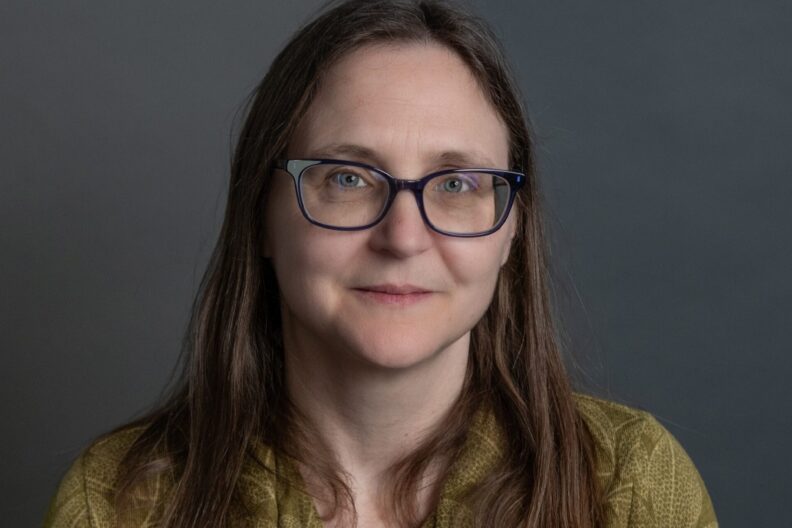
Dr Lennie Foster
“If you want your science to have real impact and really change the world, you need to think about how it’s affecting everyone. It’s not a nice-to-have. It makes your science better.”
Written by Derek Main
When researchers write a funding proposal, they know they must show how they will embed equality, diversity and inclusion (EDI) in their project. It is now part of the process. Yet for some, it can still become a box-ticking exercise, something addressed after the main ideas behind the project have already taken shape.
For Dr Lennie Foster at Loughborough University, that approach misses a vital opportunity.
“If you want your science to have real impact and really change the world, you need to think about how it’s affecting everyone,” she says. “It’s not a nice-to-have. It makes your science better.”
The gap was practical, not ideological
Led by Loughborough University, the University of Birmingham and Cranfield University, the Centre for Postdoctoral Development in Infrastructure, Cities and Energy (C-DICE) is the UK’s largest postdoctoral development programme. It aims to build the advanced skills needed to create a talent pipeline for the Infrastructure, Cities and Energy sectors and to accelerate progress towards a net-zero society. As skills manager for the programme, Dr Foster supported early-career researchers preparing funding bids and research proposals. That vantage point gave her a clear view of the challenge: the problem was not resistance, but uncertainty.
“Mandatory training already existed, and the terminology was familiar,” she explains. “But many people still didn’t understand what it meant in practice. If your research focuses on systems, modelling or infrastructure, you can feel one step removed from people. So it’s not always obvious how these questions apply when you’re designing a project.”
What happens when we don’t think it through
“Not thinking about these things can lead to unintended consequences,” says Dr Foster. “A good example was the UK Government campaign telling people to turn their thermostats down to cut energy use and emissions. The aim was sensible. But the campaign assumed most people heated their homes to around the same temperature. If you’re already living in energy poverty, your thermostat isn’t set at 20 degrees. It’s set much lower. So telling everyone to turn the heating down risks making a difficult situation even worse.”
The government was trying to reduce energy consumption and emissions, but it had not fully considered the different circumstances people faced.
In research, she argues, similar blind spots can narrow findings or weaken impact. If some groups are left out, or if a project affects people differently in ways that have not been examined, the results may be less complete and less reliable than intended.
Turning reflection into practice
The initial response was practical. C-DICE ran scenario-based workshops where participants worked through real examples and identified potential unintended consequences. The conversations were useful, but they only went so far. Researchers needed something they could return to as they developed their ideas and shaped their projects.
Through her EDI+ Fellowship, Dr Foster worked with C-DICE colleagues at Loughborough University, the University of Birmingham and the University of Nottingham to address that need. Drawing on insights from workshops, discussions with participants and focus groups, she synthesised the challenges and misconceptions they raised, translating them into scenarios and reflective activities.
The result was the Embedding EDI in Research Planning, Proposals and Practice Toolkit, a self-paced digital resource hosted on an open Canvas platform that researchers can return to throughout the project design process.
Structured across six short modules, it uses real examples to guide researchers through key decisions. Rather than offering stock phrases for proposals, it encourages them to pause and reflect: who might be left out? Could certain design choices disadvantage particular groups? What assumptions are they making without realising it? By working through these scenarios, participants can explore the implications of different design choices in a safe setting and then apply those insights to their own projects.
Early signs of change
Evaluating how people used the toolkit also formed a central part of Dr Foster’s Fellowship. Since launching in July 2025, more than 200 researchers from over 40 UK universities have engaged with the toolkit. Early feedback from the evaluation Dr Foster led through her fellowship suggests the toolkit is already changing how researchers approach their projects. Participants say they feel more confident applying inclusion in practice and are more likely to factor it into their research design, with the strongest shifts among those early in their careers.
For Dr Foster, the most meaningful evidence is seeing changes in behaviour.
She recalls a doctoral researcher who revisited his thesis corrections after completing the toolkit and revised parts of his work to reflect what he had learned.
“It’s that light bulb moment,” she says. “When people realise they’re not doing this because it’s a nice thing to do. They’re doing it because it makes their research stronger.”
Beyond the toolkit
The Fellowship has also shaped Dr Foster’s current work. She leads Equality, Diversity and Inclusion as Centre Manager for UK SCALE, the UK hub for supply chain innovation and talent development within the MIT Global SCALE Network. Joining during the start-up phase allowed her to embed inclusive practice from the outset, ensuring the Centre built EDI principles into governance, activities, and early strategy.
Drawing on the insights and tools developed through her Fellowship, she has integrated inclusive thinking into UK SCALE’s innovation cycle, events and development programmes. She also works with academics to adapt the toolkit for supply chain researchers and students, ensuring the principles remain relevant in this applied, industry-connected environment. Alongside this work, she contributes to wider sector change through her role on the EDI Advisory Board of the Association of Research Managers and Administrators and has become a trusted source of EDI expertise within Loughborough Business School.
A digital tool on its own will not change a university’s culture or fix deeper inequalities. But Dr Foster believes it can change how people think at the start of a project. By bringing inclusion into the design stage, the toolkit encourages them to consider who their work affects before locking in decisions or submitting proposals. As expectations around inclusion continue to rise, changing that early thinking may have more lasting impact than any single policy rule.
In the end, the question is not whether inclusion appears in a proposal. It is whether it shapes the thinking behind it.