Graduate apprenticeships promised to open the door to engineering. Why does it still feel half closed?

Share This
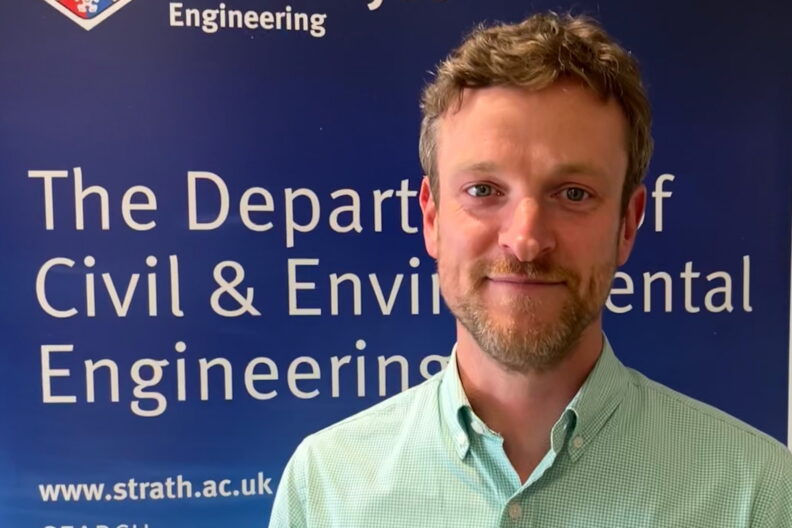
Dr Stewart Beattie
“There’s a lot of agreement with the need for diversity in the work force, but employers don’t feel empowered to make that change.”
In 2017, the Scottish Government introduced Graduate Apprenticeships (GAs) as a new route into higher education and professional work. Developed by Skills Development Scotland together with employers, colleges and universities, the programme promised to improve social mobility, tackle high-level skills gaps in sectors such as engineering, construction and IT, giving apprentices the chance to earn a salary, build workplace experience and work towards degree-level qualifications at the same time.
But almost a decade on, GA’s promise did not match the reality Dr Stewart Beattie was seeing among the cohorts of engineering students he taught every day at the University of Strathclyde. “The numbers that we were getting in terms of the male-female split and ethnic diversity were worse than our full-time equivalent programmes,” he says. “So that’s what really made us look at it at first.”
Why did the intake of a programme designed to widen participation look less diverse than the full-time route? Dr Beattie set out to answer that question by looking more closely at how access worked in practice and where it began to narrow.
Where the route begins
Unlike a traditional degree, where students apply through the university, the route into an apprenticeship depends on finding an employer first, so that’s where he began.
“Employers being the gatekeeper seems to be the main difference,” Dr Beattie says.
His conversations with employers revealed a clear pattern: recruitment differed sharply between large organisations and smaller firms.
“It’s very patchy and variable,” he explains, “usually depending on the size of the organisation. Bigger companies tend to have HR and more open processes, but in smaller companies, it’s often one engineer doing the recruitment, so you get word of mouth, school links, or just bringing in someone they already know.”
He also noticed how often employers talked about “cultural fit”. On one level, that reflected a practical desire to recruit someone who would work well with the team. But in a profession still dominated by white men, it can also steer decisions towards the familiar.
“You end up looking for people like yourself,” Dr Beattie explains, “rather than necessarily the most talented person.”
Earlier signals
As Dr Beattie spoke to students, the picture became more complex. The barriers did not begin at the interview stage. In many cases, they appeared much earlier.
“The university route is well understood in schools, but degree-level apprenticeships aren’t,” he says. “Teachers and advisers don’t always know how to support students with them, and they often get grouped with less academic or trade-based apprenticeships.”
He also saw a wider pattern: boys are more likely to be steered towards apprenticeships, while girls are less likely, even when the outcome is a degree.
When the question changed
At the outset of his EDI+ Fellowship, Dr Beattie thought the project might lead to guidance or a toolkit for employers. As the work developed, he began to question whether that would be enough.
The problem did not lie in a complete absence of advice. “We found some guidance that existed,” he says. “The issue is that it’s not being followed. When I present my findings to employers, there’s a lot of agreement with the need for diversity in the work force, but employers don’t feel empowered to make that change.”
This experience shifted Dr Beattie’s thinking. Instead of asking what new resource he could produce, he started asking a harder question. What would actually change practice, and where could any intervention make the biggest difference?
What comes next
Dr Beattie has moved into the next phase, working with a researcher in maths and statistics at Strathclyde to analyse data on apprentices’ progression and outcomes. He wants to understand what happens after students join the programme: how apprentices compare with similar students, where they may need support and what patterns emerge in progression and attainment.
“If we can understand how students are progressing, we can be more targeted in how we support them”, he explains. “It also gives us something more concrete to say about outcomes, particularly for students from underrepresented backgrounds and evidence we can use to challenge assumptions about who apprenticeships are for and to communicate that more clearly to schools, families and employers.”
Dr Beattie also wants universities, schools and employers to present the route more clearly, with wider promotion, stronger representation of successful students from different backgrounds and clearer messaging that these are full degrees open to a far broader range of people than stereotypes suggest.
“I want to find a way to get the message out that these are full degrees, and that they are open to people from all sorts of backgrounds,” he says. “But to do that, we need better evidence, something we can use to support people more effectively and to show what success actually looks like.”
What the Fellowship made possible
The EDI+ Fellowship has also shaped Dr Beattie’s work and career. It gave him space to pursue a question that mattered, connect it to a wider EDI conversation and build collaborations that now drive the next phase of the research. It also contributed to his promotion, broadening his role within Strathclyde.
His expanded role has also brought new demands, leaving less time to focus on turning the project’s early findings into practical change. But it has sharpened his sense of where that effort needs to go. The work has made the issue clearer and clarified what needs to happen next. As he puts it, “the impact of it, and what you do with that information, is as important as finding the things out themselves.”
For Dr Beattie, the question now reaches far beyond recruitment. If GAs are to widen access as they were meant to, the route has to be visible, understandable and genuinely reachable long before students arrive at an interview.