
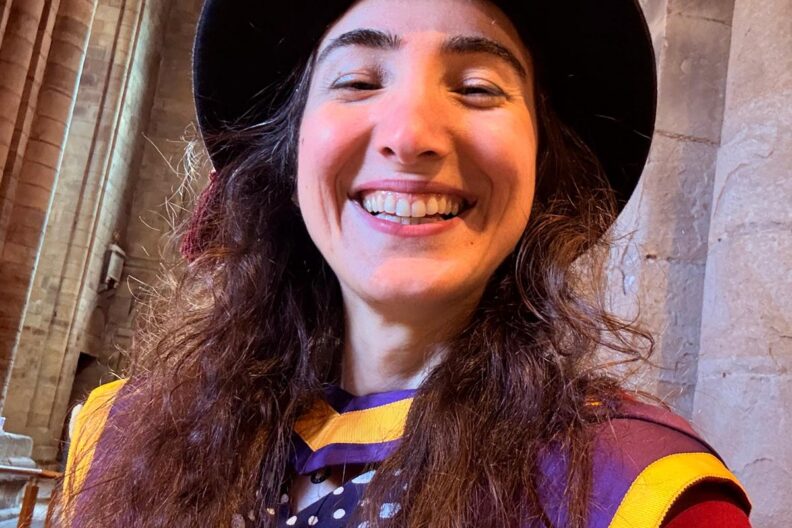
Dr Nur Sarma
“As an individual, you can change very little,” she says. “But if you are part of a team that wants to change and improve things, then you can do more, and you can do much better.”
For an early-career academic, the work of establishing a research group, recruiting students and winning first grants is demanding enough on its own. Harder still is learning a new department’s culture, with its unwritten rules that everyone around them already seems to know.
An Assistant Professor and Director of EDI and Wellbeing in the Department of Engineering at Durham University, Dr Nur Sarma was drawn to her EDI+ fellowship by something she had experienced herself: an existing mentorship programme that worked well in general terms, but that did not always reach the people whose circumstances differed most from the established norm.
“My target group includes academics who may benefit from more tailored mentorship support,” Dr Sarma says. “This includes early-career colleagues, particularly within their first five years at Durham, international academics, and female academics in engineering. These groups can face specific challenges, which means the type of guidance and support they need may differ from that of more established colleagues.”
The pattern she suspected
Dr Sarma designed the project in two stages. The first was a departmental questionnaire, which drew responses from around half the staff and gave her a baseline read on how the existing scheme was working. The second is an Action Learning Set she is running with a small group of early-career international colleagues, two men and two women, who meet across four sessions, after which she will close the cycle with a short survey before finalising her recommendations to senior management.
What she had assumed was her own experience turned out to be widely shared. The colleagues she sat down with were dealing with similar difficulties. “It was almost a validation of what I was feeling initially,” she says.
What her colleagues described, when she draws it out, is a series of small frictions that an established academic might not think to mention. Dr Sarma gives the example of abbreviations, used constantly by established staff because everyone knows what they mean, except the person who started six months ago. “They are part of the dynamic already,” she says. “They are not going to be aware that you need to learn certain things, even an abbreviation.”
Familiar ground
The international dimension widens that gap further. Moving between higher education systems means relearning not only research and teaching cultures but the social dynamics between colleagues and senior management, all while trying to perform.
Dr Sarma is also the only woman electrical engineer working in her field at Durham. As an undergraduate, she was one of two women in a class of around a hundred, and during her PhD, she was her supervisor’s first female student and remained the only woman in the research group until completing her doctorate.
“Being a minority in a group can sometimes feel isolating,” she says, “particularly when others in the group have had limited interaction with people from similar backgrounds. In those situations, colleagues may not always recognise or fully understand the specific needs or challenges that you experience.”
During her PhD, she worked on a large electric machine test rig that required handling and replacing heavy components within the setup. The equipment had been designed with little thought for the practical challenges different users might face in operating it, and she found some parts difficult to lift and move. Her supervisor, she says, did not see this as a question worth asking. Still, she took something positive from the experience that has stayed with her.
“If you are courageous enough to say or willing to change things, you can be the first of your kind, so your colleagues coming in the future do not have to struggle as much as you did.”
Mentorship done well
Mentorship can play an important role in helping institutions better support colleagues from different backgrounds and career stages. In Dr Sarma’s view, it is most effective when it is responsive to the individual experiences and needs of those receiving it.
“EDI is a very sensitive field,” she says. “It has gained significant importance in recent years, and a lot of people want to do things. But the important thing is: do you really want to do something, or are you doing it just to tick the box?”
For Dr Sarma, the answer lies in how a mentorship scheme is monitored once it is up and running. A programme works, she argues, only if the people running it are paying attention to whether the matches are right, whether they are still working months in, and whether the mentees are progressing. A bad match can hold a junior colleague back rather than push them forward.
“It is like any other relationship,” she says. “If it does not work, we can solve the problem, but only if you notice.”
From fellow to director
Since she began the fellowship, Dr Sarma has also become the department’s Director of EDI and Wellbeing, which gives the project an unusual afterlife. The recommendations she eventually makes will land in a department where she is now part of the group working to act on them.
“As an individual, you can change very little,” she says. “But if you are part of a team that wants to change and improve things, then you can do more, and you can do much better.”
EDI work, she says, has to come from the heart. The people who do it well are the ones who actually want the change, not the ones who have been asked to want it.
Whether her recommendations move the department depends on what happens next. But the fellowship has already done something more enduring: confirming that the difficulty she experienced was not hers alone.