

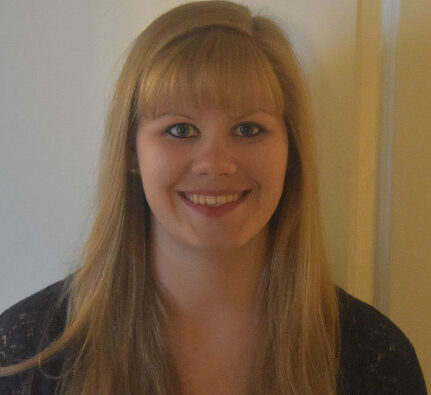
Dr Hannah Mullings
“I wanted to see the full picture.” Dr Hannah Mullings, EDI+ Fellow, the University of Manchester
Written by Derek Main
Universities are good at counting the women entering engineering, routinely tracking applications, admissions and appointments. For the past two decades, those numbers have been moving in the right direction. But they tell us much less about who stays in the discipline, and the kinds of jobs they end up doing.
A job that ends in two years can shape decisions far beyond the workplace. It can determine whether someone takes on a long-term project, moves to a new city, starts a family or begins looking for their next job before the current one has really begun.
Dr Hannah Mullings, Dame Kathleen Ollerenshaw Fellow in Civil Engineering and Management at the University of Manchester, spends most of her working life measuring how offshore renewable energy structures behave under forces that are difficult to predict. Through her EDI+ Fellowship, she applied the same quantitative methods to her own faculty, and she was herself on a fixed-term contract when she began examining how her faculty were employed.
She had also seen enough elsewhere to suspect that whatever the data showed would not be confined to one institution. “I have experienced situations, not within the institution specifically, but in other situations where I’ve thought, gosh, it really is still not great,” she says.
Beyond the headline figures
Securing an EDI+ Fellowship gave Dr Mullings the standing to request data she had previously been unable to access.“ It gave me the licence to request something,” she says.
Manchester had already collected the figures for previous Athena Swan submissions. Dr Mullings’ task was to look at them differently and find out whether what she had seen over the years was part of a wider pattern.
“I’ve seen what I’ve seen, but I wanted to see the full picture,” she says.
She hoped the data might prove her wrong. At first, the headline figures were relatively reassuring. “It’s not bad. It’s not great, but it’s not bad,” she says. But the improvement she had expected to see over time was not there.
In 2019/20, around 58% of women in the faculty were employed on fixed-term contracts, compared with roughly 51% of men. By 2024/25, both figures had fallen to about 40% of women and 33% of men.
The gap had narrowed, but it had not disappeared. Nor is the underlying issue particular to Manchester. Fixed-term employment is a structural feature of academic careers across UK higher education, and every institution is now being asked who ends up in insecure posts and who converts out of them. What was striking was how little attention the gap had received locally.
“It wasn’t a statistic that people were really using or talking about,” Dr Mullings says. “It was one of those things you had to go looking for specifically.”
What the gap means is less clear. It could reflect more women entering engineering through early-career posts, with fixed-term contracts providing a route to permanent careers. Or it could point to something less encouraging.
“Are women getting into these roles and then, somewhere along the way, falling out of the system?” Dr Mullings asks.
For her, that shifted the focus beyond recruitment. Getting more women into engineering mattered. Whether they could stay and build lasting careers mattered too.
Making the findings count
The obvious next step might have been to create an intervention in her own department. Dr Mullings saw a problem with that. Manchester was already collecting the data through Athena Swan, and setting up something separate risked duplicating the work.
“I didn’t need to create another process or collect data that was already being collected,” she says. “If this was going to have an impact, it couldn’t sit in a silo.”
Instead, Dr Mullings took the findings into the system already designed to act on them. She is now Head of Equality, Diversity, Inclusion and Accessibility for the School of Engineering. She is also leading its upcoming Athena Swan submission, bringing the findings from the fixed-term contract analysis directly into discussions about the university’s next action plan.
“It needs to have a purpose,” Dr Mullings says. “If it’s going to lead to change, people need to take notice of it, and it needs to go through the right channels.”
Asking better questions
The numbers showed Dr Mullings where the gap was. They could not tell her what was causing it, and she was wary of supplying the explanation from her own experience.
“I know what motivated me, as a woman, to study engineering,” she says. “But my experience isn’t everybody else’s.”
Two summer internships funded by the School of Engineering gave Dr Mullings a chance to think differently about how to find those answers. The work developed into a review of how focus group questions are put to staff and students in STEM, now being prepared for journal submission, and changed the questions she plans to ask.
Rather than showing academics the gender gap and asking them to explain it, Dr Mullings wants to start with what has actually helped. Has anything gone above and beyond to support you? Have you felt encouraged to go for something, anything, within the university?
The answers to such questions can speak volumes. One person might describe being encouraged to pursue a promotion or recognition of excellent performance, while another might describe being encouraged to take on a service role.
“What you’re looking for there is, is there a gender split with what people are encouraged and supported to do?” Dr Mullings says. But she is also interested in what the answers reveal about what is already working. “Action plans tend to focus on what needs fixing,” she says. “But we also need to ask what we’re doing well and make sure we keep supporting it.”
The focus groups will begin later in the year, after the fellowship has ended. But the fellowship has changed the questions they will ask.
Embracing a broader perspective
The EDI+ Fellowship has also widened Dr Mullings’ influence. Her new School-wide role marks a significant change from working within a single department.
“I’m heavily motivated, and I care,” she says. “I didn’t want it to go to somebody who wouldn’t care as much as I do.”
For Dr Mullings, it is a significant change from working within a single department. “I was quite shielded,” she says. “I didn’t have as much power to do anything outside it.”
The fellowship itself had already shown her that the pattern was not hers alone. It put Dr Mullings in rooms with engineers from other universities, talking about what it is like to work in these departments rather than about the work itself.
“It was a welcome relief to hear other people’s experiences that didn’t need to be technical,” she says. “Working within these engineering departments across the UK, and having those discussion opportunities within the fellowship was just really enlightening.”
She was clear about how much she had needed it. “I wouldn’t call it a relief from what I normally do, but just needed.”
That broader perspective now extends beyond Manchester. Last October, Dr Mullings and a colleague ran a workshop for early-career researchers through an EPSRC-funded Supergen offshore renewable energy hub. Afterwards, one attendee told them how much it had meant to see two women leading the session, adding that at many similar events they did not feel they belonged.
“It was the loveliest bit of feedback,” Dr Mullings says.
The EDI+ Fellowship did not create that awareness. Dr Mullings’ own experience had already shaped how she thought about who feels welcome in engineering. But it gave her the space, confidence and wider perspective to turn that instinct into something more deliberate.
“Almost everything I’m doing now, I’m thinking, how does this work for everybody in the room?”